Engineer thinking vs brand thinking
Creating any new thing is a huge challenge, filled with obstacles. Anyone who’s ever done it knows how hard it is to make a new thing work, how many ways there are to get it wrong. So of course you put some effort into minimizing those risks.
The best way to make sure something works is to build it from things that worked before, and combine them in new ways.
“Creativity is just connecting things,” said Steve Jobs. “When you ask creative people how they did something, they feel a little guilty because they didn't really do it. They just saw something.”
Most innovation is seeing and building new combinations of things. As we combine things in new ways to make something new, it makes sense to begin with component parts that we can count on to work.
This is the engineer’s fundamental question:
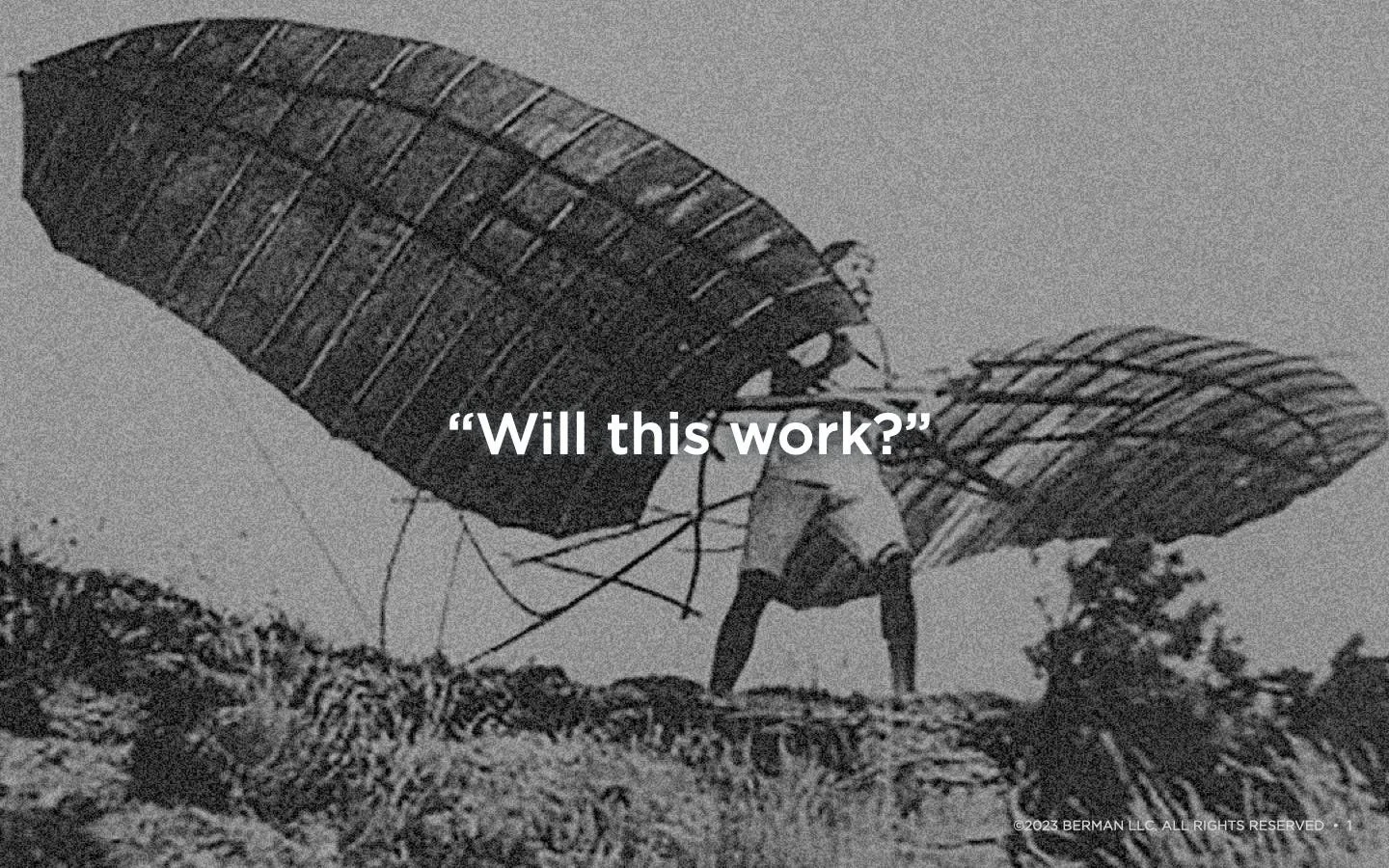
Every new thing is built upon things that came before. And because every creator wants to minimize the risk of failure, they build upon a foundation of things that have been proven to work. The fewer unknown parts to contend with, the more likely the new thing will work.
This question — Will it work? — the question at the foundation of creating something new is the exact path to failure in attracting attention to your new thing.
Good engineer thinking — what makes it possible to make the new thing work — is the mindset that leads to failure in bringing your new thing to market.
Here’s how engineer thinking fails. When it comes time to take your new thing to market, it’s natural to apply the thinking that’s brought you this far, that led to the creation of your new thing.
You don’t even consider there might be a problem with this method. To many creators, it seems like the only logical way to think about anything.
You look around at other successful things, and then apply what seems to work. So as you bring your new thing to market, you obviously want to use what has worked for others: what kind of message, what design, what look and feel, what media to reach the customers you imagine.
And your new thing gets ignored.
Not evaluated and rejected. Just flat ignored. The people you’re thinking of as customers pay zero attention to your thing, for a simple reason: because that’s how people work.
We people, all of us, are hardwired to ignore what we’ve seen before.
The very thinking that guided you in creating your new thing — build upon what works — is exactly what guarantees people will ignore it now. It’s not that you’re doing it wrong. It’s that the kind of thinking that works so well to create your new thing is making it invisible to the people you want as customers.
The brander’s question
Getting people to pay attention to your new thing takes a different mindset, because you’re actually solving a different problem. Where the engineer’s question is “Will it work?”, the brander’s question is entirely different:

The solutions to these two questions are almost exact opposites. For the engineer, making it work is building upon what worked before. Others made something work, and their success is a good foundation for yours.
For the brander, getting anyone to care about your thing means distinguishing it from what else is out there. Where the engineer is happy to make it similar to what worked before, the goal of the brander is to make it different.
To succeed, you need to transition from engineer thinking to brand thinking.
How Not to Fail
1 No one eagerly awaits your message.
2 Answer the question they’re already asking.
3 You’ve got a better message than “How It Works”.
4 Attention is not rational.
5 Think of your creation as the tangible expression of a deeper value.
6 Design is a force multiplier.
7 Companies don’t make decisions. People do.
8 Customers move toward you step-by-step.
9 Build your message on human truths.
10 You can tell when you’re getting it right.